Into Zomia: Travel, History and Ethnography in Deep Asia
History and ethnography of northwest Vietnam and Laos
Created: 5/16/2026 8:37:17
Updated: 5/16/2026 10:11:33
Exported: 5/16/2026 13:33:41
Prompt:
16/05/2026, 08:37:17
Good morning!
I do love using Google Maps for trip planning. The attached screenshots show my plan for the next week or so. One more night in Sapa then a night in Muong Lay, three nights in Dien Bien Phu, a night in Tay Trang then across the border to spend a night or two in Muang Khua. Finally to Phongsali.
What can you tell me about the history of the region I will be travelling through. All I know is that it covers Scott's Zomia and that Dien Bien Phu was the place of the French defeat in the Franco-Indochinese War. Can you provide more details please going as deeply and broadly as needed to be comprehensive, covering ethnography, politics, geo-politics, economics, everything haha
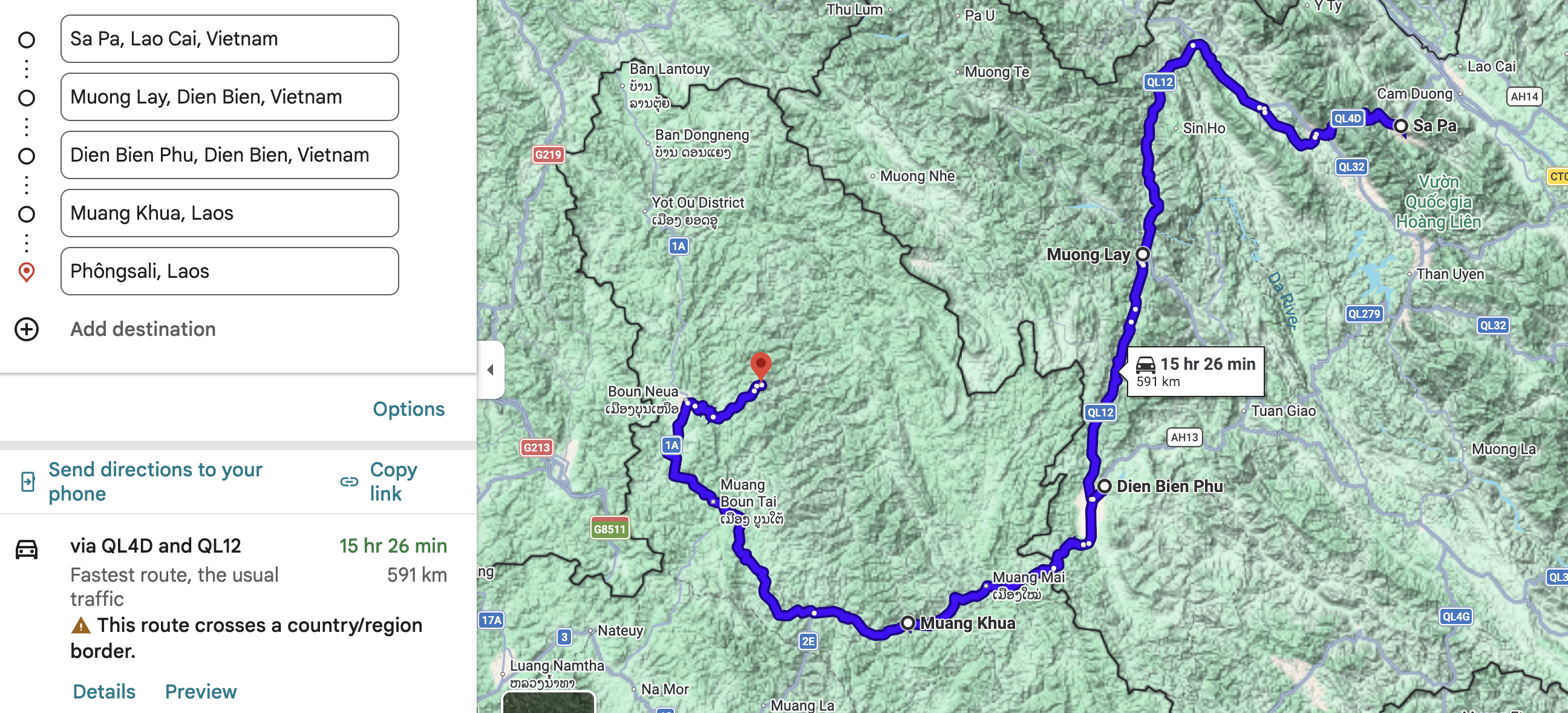
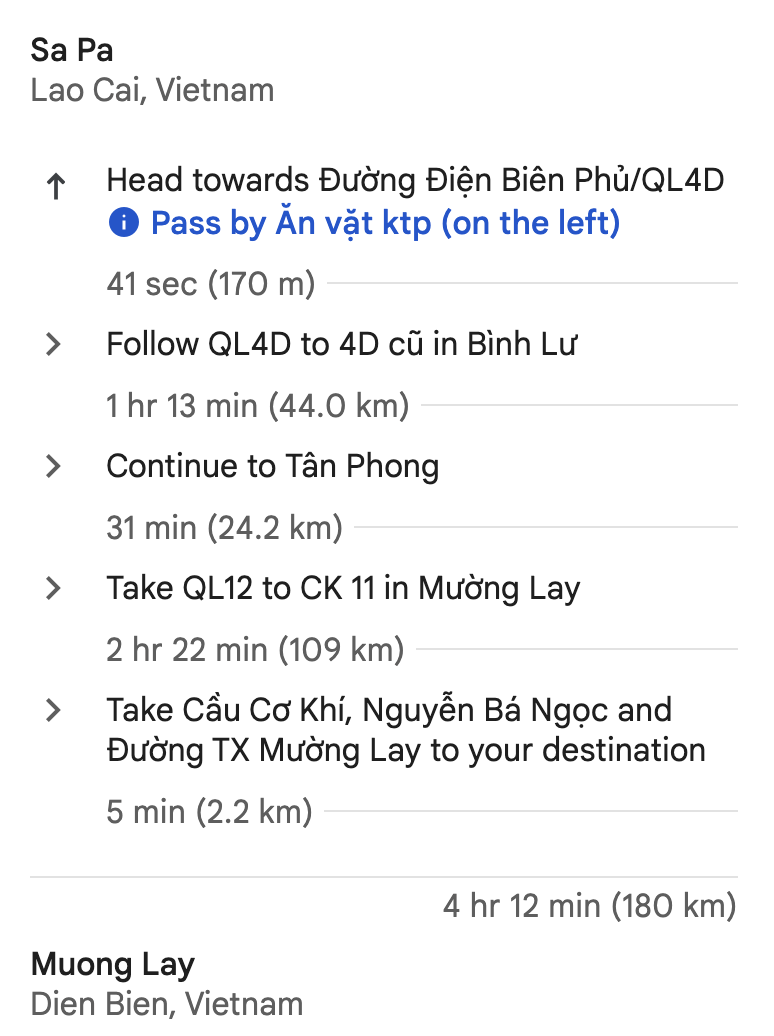
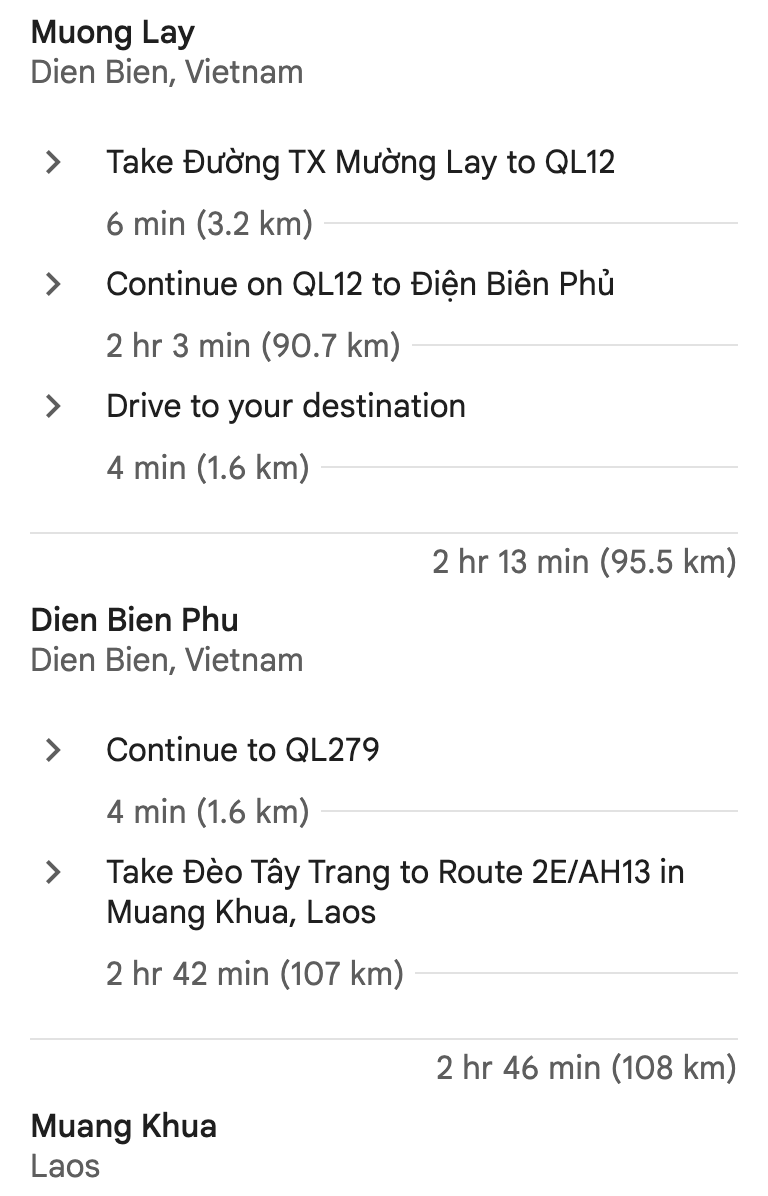
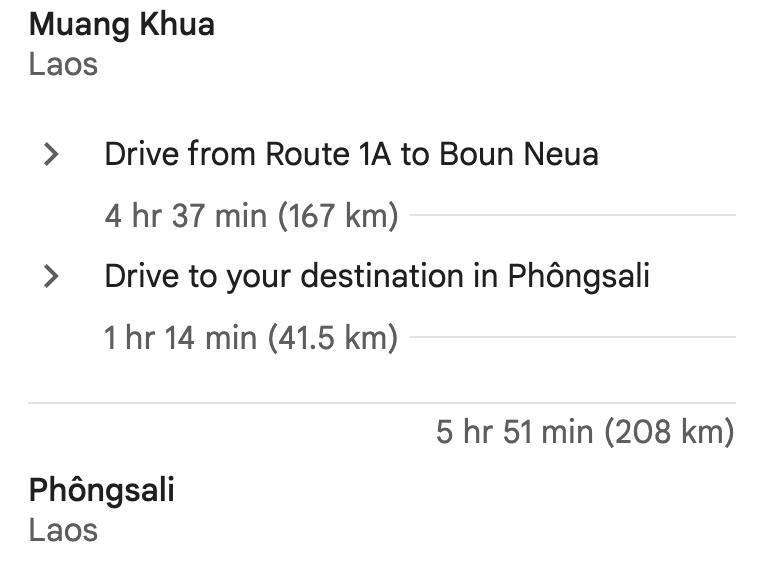
Response:
16/05/2026, 08:39:59
Web Search: Zomia Southeast Asia highlands history James Scott
The Art of Not Being Governed: Hill Peoples and Valley Kingdoms in Mainland Southeast Asia | Void Network voidnetwork.gr
Zomia — James Scott on highland peoples undsoc.org
Zomia, Land Without State - Books & ideas booksandideas.net
Understanding Society: Zomia -- James Scott on highland peoples blogspot.com
Editorial – Zomia and beyond* | Journal of Global History | Cambridge Core cambridge.org
The art of not being governed: an anarchist history of upland southeast Asia | libcom.org libcom.org
The Art of Not Being Governed - Wikipedia wikipedia.org
Southeast Asian Massif - Wikipedia wikipedia.org
The Battle Over Zomia chronicle.com
The Art of Not Being Governed: Hill Peoples and Valley Kingdoms in Mainland Southeast Asia - Cornell Video cornell.edu
Web Search: Battle of Dien Bien Phu 1954 history significance
Battle of Dien Bien Phu - Wikipedia wikipedia.org
Battle of Dien Bien Phu - Background, Outcome & Fallout | HISTORY history.com
Battle of Dien Bien Phu | History, Outcome, & Legacy | Britannica britannica.com
Dien Bien Phu & the Fall of French Indochina, 1954 state.gov
Battle of Dien Bien Phu | Military History and Science | Research Starters | EBSCO Research ebsco.com
Battle of Dien Bien Phu | French Foreign Legion Information foreignlegion.info
The Lessons Of Dien Bien Phu | Hoover Institution The Lessons Of Dien Bien Phu hoover.org
The Fall of Dien Bien Phu and the Rise of U.S. Involvement in Vietnam – Association for Diplomatic Studies & Training adst.org
Web Search: ethnic minorities northwest Vietnam Tai Black White Red Hmong history
Explore the cultural diversity of ethnic minorities in Vietnam asiakingtravel.com
Ethnic Groups in Vietnam (+Minorities) ▶️ | 2026 north-vietnam.com
Hill Tribes In Vietnam: 4 Amazing Vietnamese Tribes In Sapa worldtravelconnector.com
The Hmong Ethnicity in Vietnam: History, Culture, and ... kampatour.com
The Black Hmong of Sapa | History, Culture & Traditions in Northern Vietnam | ETHOS - Spirit of the Community ethosspirit.com
Introduction to the ethnic minorities of Vietnam - Parfum d’Automne parfumdautomne.fr
The Enchanting World of Ethnic Minorities of Northern Vietnam mrlinhadventure.com
Web Search: Phongsali Muang Khua Laos history ethnic minorities Akha Phunoi opium
Phongsaly province - Wikipedia wikipedia.org
(PDF) Ethnic groups of Phongsaly province (Laos). 2. ethnics groups: Khmu and Bit, Lao and Tai, Phounoy and Seng, Akha and relatives, Others groups. academia.edu
Phongsaly discoverlaos.today
(PDF) Ethnics groups of Phongsaly province (Laos). 1. The province and its inhabitants: geography, history, ethnicity, settlement, relatives and neighbors. academia.edu
Phongsaly Province - Alchetron, The Free Social Encyclopedia alchetron.com
(PDF) Mountain People in the Muang: Creation and Governance of a Tai Polity in Northern Laos academia.edu
Phongsaly Province tourismlaos.org
Ecotourism in Northern Laos' treasure of Phongsali | Responsible Tourism Guide to the Mekong mekongresponsibletourism.org
The Akha - Hill tribes of Thailand and Laos allpointseast.com
Phunoi corpus - Collection Pangloss - CNRS cnrs.fr
Web Search: opium Golden Triangle history French Indochina Hmong northwest Vietnam Laos
Golden Triangle | History, Tourism, & Facts | Britannica britannica.com
Guide to Investigating Organized Crime in the Golden Triangle — Introduction gijn.org
The Golden Triangle Part 1: An Opium History – My Thailand mythailand.blog
The Golden Triangle Part 1: An Opium History ⋆ My Thailand mythailand.blog
The Golden Triangle Opium Trade: An Overview By Bertil Lintner psu.edu
Heritage Line Magazine I The History of Golden Triangle heritage-line.com
Web Search: Tai Federation northwest Vietnam history Muong Lay Sapa pre-colonial
Sip Song Chau Tai - Wikipedia wikipedia.org
History - Tai Studies Center taistudiescenter.org
>Sipsong Chau Tai globalsecurity.org
The Ultimate Guide To Sapa: Vietnam's Answer To The Swiss Alps twobirdsbreakingfree.com
Northwest Vietnam and Sapa ganeandmarshall.com
Thái people (Vietnam) - Wikipedia wikipedia.org
Why Sapa and Lao Cai Will Transform your Vietnam Experience - Travelogues from Remote Lands remotelands.com
History of Sapa | French Colonial Heritage, Ethnic Culture & Tourism in Vietnam | ETHOS - Spirit of the Community ethosspirit.com
Web Search: Secret War Laos CIA Hmong Vietnam War Ho Chi Minh Trail Pathet Lao
Unveiling Secret War Laos: Tales from U.S. Allied Lao Veterans and CIA and U.S. Army Special Forces during the Vietnam War (Second Indochina War) | 4 Corners of the World loc.gov
Laotian Civil War - Wikipedia wikipedia.org
Laos “Secret Warriors” In 1961, when the Vietnam War ... akleg.gov
Learn Uake - The Secret War in a Global Context learnuake.org
Learn Uake - The Secret War Impact on the Hmong learnuake.org
Laos “Secret Warriors” akleg.gov
Why the Laotian Civil War is Also Known as the “Secret War” explorethearchive.com
The Secret War tourismlaos.org
Laos | The Secret War - The Documentarian thedocumentarian.org
Good morning! What a magnificent journey you have planned — you're cutting through one of the most historically, ethnographically and geopolitically layered corridors on earth. Let me take you through it all comprehensively, stop by stop and theme by theme.
—————
THE GREAT FRAME: ZOMIA
You're right to begin here. James Scott's concept of Zomia describes virtually all the lands at altitudes above roughly three hundred metres, stretching from the Central Highlands of Vietnam to northeastern India and traversing five Southeast Asian nations — Vietnam, Cambodia, Laos, Thailand, and Burma — and four provinces of China. It is an expanse of 2.5 million square kilometres containing about one hundred million minority peoples of truly bewildering ethnic and linguistic variety.
The key intellectual provocation of Scott's 2009 book The Art of Not Being Governed is this: highland cultures and systems are more or less deliberately shaped to elude the grasp of the state. Linguistic variety, swidden (slash-and-burn) agriculture, and ethnic opacity all work to make the art of rational administration all but impossible. In other words, the people you will encounter — the Hmong, the Black Tai, the Akha, the Phunoi — are not "primitive" or "left behind." Far from being remnants left behind by civilising societies, they are "barbarians by choice," peoples who have deliberately put distance between themselves and lowland state-centres.
This is the lens through which everything else on your route should be understood: a centuries-long, ongoing negotiation between mountain peoples who prize autonomy and valley-based states (Chinese, Vietnamese, Lao, French, and now socialist) that have perpetually tried to bring them to heel.
—————
SAPA AND THE LAO CAI HIGHLANDS
Sapa sits in the Hoàng Liên Sơn range — the "Tonkinese Alps" — an eastern extension of the Himalayas. The town was established by French colonial administrators in the early part of the 20th century. Desperate to escape the summer heat of the Red River Delta, the early settlers were attracted by Sapa's favourable continental climate and aimed to establish a summer retreat at the existing Black Hmong settlement.
Before the French arrived, the highlands around Lao Cai were fiercely contested. During the nineteenth century the Lao Cai highlands were fiercely contested. Armed bands known as the Black Pavilion and White Pavilion gangs, expelled from China after the Taiping Rebellion, sought to dominate trade along the Red River. This commerce included opium from Yunnan, sea salt from Vietnam, rice, textiles, and manufactured goods.
The people you'll see around Sapa reflect this layered history. In the Sapa district, 52% of the population is Hmong, 25% are Red Dao, 5% are Tay, with smaller Giay, Muong, and Thai communities. Each hill tribe has its unique language, culture, and historical background.
The Hmong are originally from southern China. Chinese chronicles describe them as part of the ancient San Miao nation, with origins predating the Han Dynasty. Once living in the Yellow River basin, the Hmong gradually migrated south over centuries, and large migration waves in the 18th and 19th centuries finally brought them into the highlands of northern Vietnam. The subgroups — Black, White, Red, Flower, Green — are distinguished by dress, dialect, and custom.
The Dao (Red Dao) around Sapa are known for their extraordinary textile work and the distinctive red headdresses of the women. They practice animism and ancestor veneration, with shamanic traditions still very much alive.
—————
THE ROAD FROM SAPA TO MUONG LAY: THE TAI FEDERATION
As you descend from Sapa onto QL12 and head towards Muong Lay (Lai Châu province), you enter the heartland of the Tai peoples — the most politically consequential ethnic group in this part of the world.
The region was historically called Sip Song Chau Tai — "the Twelve Tai Principalities." Before the arrival of the French in the 19th century, the Tai Country was independent, though its "crossroads" location subjected it to exploitation by Vietnam, China, and Laos.
The Tai are divided into White Tai (Tai Don) and Black Tai (Tai Dam) — named for the colours of the women's traditional dress, not skin. The Sip Song Chau Tai was incorporated into the French protectorate of Tonkin after 1888. This was arranged by the French explorer Auguste Pavie, who signed a treaty with Đèo Văn Trị, the White Tai lord of Muang Lay, on 7 April 1889, whereby the Sip Song Chau Tai accepted French overlordship while the colonial power promised to respect the positions of the Tai lords and their autonomy in internal affairs.
The French then formalised this into the Tai Federation in 1948. The Federation had its own flag, constitution and parliament, with Đèo Văn Long appointed president for life and Lai Châu chosen as the capital. However it was not only populated by Tai peoples but also Hmong, Yao, Yi and Khmu, who were labelled "sub-minorities" and treated as inferior to the Tai.
Muong Lay itself (you'll overnight here) sits in the Da River valley. It has the quiet, end-of-the-earth feeling of a river town that was once the seat of genuine Tai aristocratic power. The town was significantly affected by the construction of the Sơn La hydroelectric dam in the 2000s, which displaced tens of thousands of people — a story of socialist-era state-building that mirrors, in some ways, the old patterns of highland peoples being forcibly resettled into zones more legible to and controllable by the state.
—————
DIEN BIEN PHU: THE PIVOT OF MODERN HISTORY
The Name and the Place
You'll spend three nights here — wisely, because this valley rewards deep attention. The name "Dien Bien Phu" was Vietnamese. It was a name given by the Vietnamese to one of the Tai cities, Muong Theng, which means "the arena of gods." It was one of the Tai people's most respected cities. The valley — heart-shaped, surrounded by jungle-covered hills — had been a Tai rice-growing basin for centuries.
The Battle
The Battle of Dien Bien Phu, fought from March 13 to May 7, 1954, was a decisive Vietnamese military victory that brought an end to French colonial rule in Vietnam. In its wake came the separation of the country into North and South Vietnam, creating the political framework for continued conflict and, ultimately, the Vietnam War.
The French strategic logic was seductive but fatally flawed. The French aimed to lure the Viet Minh into a conventional battle where their technological superiority could prevail, establishing a base at Dien Bien Phu, which was strategically chosen for its isolation and supposed defensibility. The surrounding mountainous terrain would presumably prevent the Viet Minh from amassing artillery.
They were catastrophically wrong. Viet Minh General Vo Nguyen Giap mobilised a force of around 60,000 troops, cleverly bringing in artillery and launching a protracted siege that severely disrupted French supply lines. By March 1954, artillery bombardments had compromised the French position, leading to the eventual overrun of their defences. The battle culminated on May 7, 1954, with a significant defeat for the French, resulting in nearly 2,300 fatalities and the capture of surviving soldiers.
The human logistics of the Viet Minh operation were staggering: artillery pieces were physically manhandled through dense jungle and up steep mountain slopes by tens of thousands of porters — a feat the French genuinely believed impossible.
The Geopolitics
The battle was not simply a Franco-Vietnamese affair. The conflict in French Indochina between 1950 and 1954 was nothing short of a proxy confrontation in the ideologically driven Cold War between the Communist bloc and the West, mapped out in late December 1949 and early 1950 in Moscow among Stalin, Mao, and Ho Chi Minh. Chinese military advisors and Chinese-supplied Soviet weaponry were decisive. Without the Chinese supply of these weapons and the Chinese military delegation, who directed General Giap's every order, the Viet Minh could not have won the battle so easily, or perhaps even at all.
The American dimension: The fall of Dien Bien Phu was a disaster not just for France but also for the United States, who by 1954 was underwriting 80% of French expenditures in Indochina.
The Aftermath
The defeat brought a profound psychological shock to France. It led to a gradual withdrawal of French forces from Indochina, agreed in the 1954 Geneva Accords signed ten weeks after the battle. Vietnam was temporarily divided at the 17th parallel, with the North assigned to the Democratic Republic of Vietnam under Ho Chi Minh and the South to the State of Vietnam. The partition was supposed to be temporary, and the two zones were meant to be reunited through national elections in 1956, which were never held.
The French sense of national humiliation, particularly acute within the army, had lasting repercussions on French public opinion and contributed — along with later events in Algeria — to the downfall of the Fourth Republic in 1958.
Dien Bien Phu marked the first time a non-European colonial independence movement, which had evolved from guerrilla bands to a conventional army, had been able to defeat a modern Western occupier. Its psychological reverberations echo through the entire anti-colonial world: from Algeria to Angola to Cuba.
What to See
Today Dien Bien Phu has a modern museum and much of the battlefield is preserved, including several of the fortified French positions, the bunkered French headquarters, and the Viet Minh headquarters complex. Regular commercial flights from Hanoi land at the same airstrip, now paved in concrete. Three days is enough to do the battlefield justice, visit the museum, and also explore the living Tai culture of the valley.
—————
THE TAI FEDERATION'S OTHER PEOPLES: HMONG AT DIEN BIEN
In Điện Biên Province, Hmong communities have long inhabited upland hamlets. They played important roles during the First Indochina War, including guidance, portering and other contributions during the campaign that culminated at Điện Biên Phủ in 1954. The Hmong's knowledge of the terrain was invaluable to both sides, and their subsequent fates after 1954 diverged sharply depending on which side they had supported.
—————
OPIUM: THE COLONIAL ECONOMY OF THE HIGHLANDS
No picture of this region is complete without understanding opium. By 1900, tax on opium accounted for more than half of all revenues in French Indochina. In 1930, the territory had 3,500 licensed opium dens, or one for every 1,500 adult males.
The French didn't merely tolerate the trade — they structurally relied on it. The war had meant that sea routes from India and West Asia had become insecure, which prompted the French to encourage poppy cultivation in the highlands of northwestern Tonkin and Laos. The crop was grown mainly by Hmong tribes and the Yaos, and to some extent by the Lahus and Lisus. The French employed Chinese middlemen who had some capital and were able to advance money, paying for the opium in cash and making a handsome margin between the price paid to peasants and the payment received from the French authorities.
This extractive relationship entangled the highland peoples in the colonial economy while simultaneously making them economically dependent on a crop that was illegal in most of the world and that the colonial power controlled entirely. The CIA later continued a version of this arrangement — using the profits of Hmong opium production, moved by Air America, to partially finance the Secret War in Laos.
—————
CROSSING INTO LAOS: TAY TRANG AND MUANG KHUA
The Tay Trang border crossing is one of only a handful of land crossings between Vietnam and Laos, and it sits at the edge of what was once a fluid, borderless world. The concept of a fixed international boundary here is entirely a product of French colonialism — before that, the Tai lords of Muang Lay exercised authority that bled imperceptibly across what is now the frontier.
Muang Khua sits on the Nam Ou River — a tributary of the Mekong — and is a small river port that remains genuinely off the tourist trail. Mouang Khua is a small river port on the picturesque Nam Ou River. The Nam Ou was for centuries a trade and communication artery connecting the deep north of Laos with Luang Prabang and the Mekong.
The peoples around Muang Khua are predominantly Khmu (an ancient Austroasiatic-speaking people who pre-date the Tai migrations into the region) and various Tai groups. The Khmu are often described as the "original inhabitants" of much of northern Laos, with the Tai arriving later and gradually displacing or subordinating them.
—————
PHONGSALI: THE DEEP NORTH
Phongsali is the most remote of your destinations and arguably the most extraordinary. Phongsaly province borders China to the north and west, Vietnam to the east, Luang Prabang province to the south, and Oudomxai province to the southwest.
Ethnography
The population includes 28 different ethnic groups, of which the majority are Khmu, Phounoy, different Akha, Tai Lue, and Hor; each with their own culture, traditions, costumes, and language.
The Phunoi (also Phu Noi or Phounoy) are the dominant highland group of the province and linguistically belong to the Loloish subgroup of the Sino-Tibetan family — making them distant relatives of the Tibetans and much closer relatives of the Akha and Yi of Yunnan. The Phunoi left Muang Sing or Burma and arrived in Phongsaly at the end of the 18th century.
The Akha are perhaps the most visually striking group. The Akha originated in the Tibetan plateau and gradually migrated south through Yunnan, China, and Myanmar in the mid-19th century, settling in the mountainous regions of northwestern Laos. They are known for elaborate silver headdresses, animist religion, and the concept of the "Akha Way" (Akhazang) — a holistic code governing all aspects of life from agriculture to birth rituals. Most villages will have untouchable gates which mark the boundary between the human and natural worlds. A highlight of an Akha visit is the annual swing ceremony held between mid-August and September.
The Hor (also known as Haw) living in Phongsali town itself are ethnic Chinese, descendants of Yunnanese traders and, in some cases, Kuomintang soldiers who drifted south after 1949. Phongsali town features a remaining old quarter with Yunnanese wooden architecture, now rare to find in Yunnan itself. Most of the people living here belong to the Hor ethnic group, speaking Chinese.
This is one of the great ironies of the region: to find the best-preserved Yunnanese architecture, you now have to go to Laos.
Tea
The Chinese-style green tea of Phongsaly receives worldwide recognition for its high quality and superb taste. Tea leaves are picked by the Phounoy minority women from tea trees up to 400 years old, standing 6 metres high with a stem up to 30 centimetres in diameter. These ancient tea gardens are a living link to the old Yunnan-Southeast Asia tea trade routes.
Colonial and Revolutionary History
In 1895, a Sino-French treaty transferred the Tai Lue's Sip Song Phan Na principalities of Phongsaly and Muang Sing to French Laos. Between 1908 and 1910, the Tai Lue conducted a revolt against colonial authority.
The province became deeply entangled in the revolutionary politics of the mid-20th century. In 1936, Sithon Kommadam and his brother Kamphanh were jailed in Phongsaly because of their participation in their father's 1934–1936 armed revolt against the French. After Sithon's release in 1945, he established resistance bases in Phongsaly, soon making contact with the Viet Minh. The Communists came into power in 1954 in the province.
Subsequent to the 1954 Geneva Accords, Communist Pathet Lao forces in Phongsaly province were provided with regrouping zones. Phongsaly was essentially a Pathet Lao stronghold from very early in the Laotian civil war.
—————
THE SECRET WAR IN LAOS
The whole of northern Laos — the landscape you'll be crossing — was a battlefield in one of the 20th century's most morally complex conflicts. The Laotian Civil War was waged between the Communist Pathet Lao and the Royal Lao Government from 1959 to 1975. The Kingdom of Laos was a covert theatre during the Vietnam War, with both sides receiving heavy external support in a proxy war between the global Cold War superpowers.
The U.S. Central Intelligence Agency, in an effort to disrupt North Vietnamese operations in northern Laos without direct U.S. military involvement, responded by training a guerrilla force of about 30,000 Laotian hill tribesmen known as Special Guerrilla Units, consisting mostly of Hmong tribesmen along with Mien and Khmu, led by Royal Lao Army General Vang Pao.
By 1971, some historians estimated that over one-third of the total Hmong population in Laos had died. Additionally, half of all Hmong males over the age of 15 were killed in combat. As a result, many Hmong families had to give up sons as young as 10 years old to participate in the war.
From 1964 to 1973, the U.S. dropped more than two million tons of ordnance on Laos during 580,000 bombing missions — equal to a planeload of bombs every 8 minutes, 24 hours a day, for 9 years — making Laos the most heavily bombed country per capita in history. Up to a third of the bombs dropped did not explode, leaving Laos contaminated with vast quantities of unexploded ordnance (UXO). Over 20,000 people have been killed or injured by UXO in Laos since the bombing ceased.
Phongsali itself was largely spared direct bombing, and unlike many other cities in Laos, Phongsali Town was not destroyed in the American war — which is precisely why its old Yunnanese quarter survives.
—————
BROADER GEOPOLITICAL THEMES
China's Shadow. The entire corridor you're travelling sits in China's geopolitical backyard. Phôngsali is the primary trade gateway between Laos and China, exporting lumber and importing types of finished goods. Chinese investment and infrastructure are now transforming this region rapidly — the Boten–Vientiane railway (the Laos–China Railway, opened 2021) has shifted economic gravity dramatically southward. The ancient Yunnanese trade networks are being superseded by Belt and Road infrastructure.
The Highland–Lowland Dialectic. Throughout your journey you'll see the ongoing tension Scott describes: socialist governments in both Vietnam and Laos have pursued sedentarisation policies, banning swidden (shifting) agriculture, resettling upland communities into the valleys, mandating cash-crop cultivation, and integrating highland children into lowland school systems. The last 15 years have seen the state become a more significant reality for villagers, with a swath of policies implemented locally: resettlement, land reform, mandatory commercial plantations, a shifting cultivation ban, a hunting ban. This is Scott's thesis playing out in real time.
The Tai Diaspora. After the Vietnamese victory at Dien Bien Phu and the Geneva Conference of 1954, the Tai people in Hanoi became refugees overnight. Afraid of persecution, they fled to South Vietnam and Laos. The Black Tai (Tai Dam) eventually scattered as far as Iowa and France, forming one of the most geographically dispersed highland diasporas on earth.
—————
A NOTE ON WHAT YOU'LL EXPERIENCE ON THE GROUND
The road from Dien Bien Phu to Tay Trang, and from there through to Muang Khua and Phongsali (Route 2E / the 1A through Laos), is extraordinary terrain — some of the most dramatic in Southeast Asia. You'll see women in traditional dress at roadside markets who are making journeys between villages on a weekly market circuit that has operated for centuries. The linguistic diversity is astonishing: in a single day's drive you might pass through communities speaking Tai Dam, Khmu, Hmong, and Akha — four completely unrelated language families.
Phongsali's market is worth rising early for — traders from the surrounding hills come down in the mornings, and it remains one of the most ethnographically vivid markets in Laos.
You're going somewhere genuinely remarkable. Have a wonderful journey.
Prompt:
16/05/2026, 08:55:46
Wow! The trips I plan in ignorance haha
Visa requirements mean that I cannot stay on the Vietnamese side of the border for longer than planned but Laos is a different matter. I initially thought to spend about two months in Phongsali then make my way to Houayxay to cross over into Northern Thailand. Starting from Muang Khua, would you recommend staying longer in any places along that route from Muang Khua to Phongsali then to Houayxay? Perhaps Luang Namtha? I don't know the region at all but your description above shows me that it is a rich environment to absorb.
Response:
16/05/2026, 08:57:21
Web Search: Muang Khua to Phongsali route Nam Ou river boat overland options
Getting to Phongsaly – Wearelao.com wearelao.com
Getting to and around northern Laos — Loren's Wanderlust lorenswanderlust.net
The gorgeous Ou River Valley: Nong Khiaw, Muang Ngoi, and Muang Khua — Loren's Wanderlust lorenswanderlust.net
Muang Khua guide in Laos for independent tourists nashaplaneta.net
Cruising down Nam Ou River (Phongsaly to Nong Khiaw) | On the road in Asia wordpress.com
How to get to Muang Khua | Travelfish travelfish.org
Muang Khua to Phongsali - Phongsaly Province Forum - Tripadvisor tripadvisor.com.sg
How to get to Phongsali | Travelfish travelfish.org
River Travel Nong Khiaw To Phongsali | Laos travel forum travelfish.org
The Nam Ou River via Nong Khiaw and Muang Ngoi in Laos — Ben Howe benhowe.co.nz
Web Search: Luang Namtha trekking ethnic villages history Nam Ha NPA 2025
2025 Nam Ha NPA 3 Day Wildlife Jungle Camp and Village Homestay Trek (Luang Namtha) - with Trusted Reviews tripadvisor.com
2025 Nalan Trail and Khmu Tribe: 2 Days Trek in Nam Ha NPA (Luang Namtha) - with Reviews tripadvisor.com
2025 Jungle Experience: 1 Day Trek in Nam Ha NPA (Luang Namtha) - with Trusted Reviews tripadvisor.com
What to Dos in Nam Ha NPA – Nam Ha namha-npa.org
Why Luang Namtha is Laos’ Best-Kept Secret Treasure? kampatour.com
Luang Namtha Trek :: Luang Namtha Hiking :: Hiking in Luang Namtha – Your Trek Benefits to Villager, Nature & Culture luangnamthatrek.com
What to Dos in Nam Ha NPA namha-npa.org
Web Search: Muang Sing Laos history Tai Lue Golden Triangle border Akha
Muang Sing – Travel guide at Wikivoyage wikivoyage.org
Muang Sing Travel - When to visit - What to see & do - Where to stay sonasia-holiday.com
HILL TRIBE TREKS, OPIUM, LUANG NAM THAT AND MUANG SING | Facts and Details factsanddetails.com
Lue across Borders: Pilgrimage and the Muang Sing Reliquary in Northern Laos (Chapter 7) - Where China Meets Southeast Asia cambridge.org
Luang Namtha - traveltoasiaandback.com traveltoasiaandback.com
Golden Triangle (Southeast Asia) - Wikipedia wikipedia.org
Golden Triangle | History, Tourism, & Facts | Britannica britannica.com
6 Days Trek Golden Triangle through Authentic Ethnic Diversity – Phou Iu Travel & Ecotourism, Laos phouiu-ecotourism-laos.com
7 Days Trek Golden Triangle through Unique Ethnic Diversity – Phou Iu Travel & Ecotourism, Laos phouiu-ecotourism-laos.com
Muang Sing: the beautiful hill tribe villages of Laos - Backpack Adventures backpackadventures.org
Web Search: Nong Khiaw Laos travel stay karst scenery trekking how long
Nong Khiaw: 3 days of total calm in this haven of northern Laos novo-monde.com
Nong Khiaw Complete Guide: Sunrise Hikes & 3 Day Itinerary offtogetlost.com
2 Days Relaxing in Nong Khiaw, Laos - Becky Exploring beckyexploring.com
Ultimate Nong Khiaw 3 Day Adventure Travel Itinerary, Laos theworldbyjames.com
Nong Khiaw - The Complete Guide — Adventures of Jellie adventuresofjellie.com
Nong Khiaw: countryside with amazing viewpoints - Pin Your Footsteps - Travel Blog pinyourfootsteps.com
Laos, Nong Khiaw : Nong Khiaw Trek, Cultural Activities, and Home Stay - 2 Days | Experience Ethnic Cultural Activities - Laos-Adventures.com by Tiger Trail Travel Laos laos-adventures.com
Laos: Travel from Luang Prabang to Nong Khiaw bizarrejourneys.com
The Ultimate Nong Khiaw, Laos Travel Guide - Fabio Nodari fabionodariphoto.com
A Complete Guide to Nong Khiaw, Laos - Passports and Preemies passportsandpreemies.com
Good — two months is a very sensible length of time for this region, and the instinct to ask about Luang Namtha is exactly right. Let me give you a practical and informed picture of the whole route.
—————
THE OVERALL SHAPE OF THE JOURNEY
Your route from Muang Khua to Houayxay (for the Thai border crossing) passes through one of the most spectacular and least-touristed corridors in Southeast Asia. The rough sequence is:
Muang Khua → Phongsali → (back south by boat/bus) → Nong Khiaw → Muang Ngoi → Luang Namtha → Muang Sing → Houayxay
There's an important geographical wrinkle to understand from the outset: the Chinese have built a series of dams on the Nam Ou River, which has dramatically changed how this corridor works. The only navigable part of the Nam Ou river is now between Nong Khiaw, Muang Ngoi, and Muang Khua. When travelling by boat to or from Muang Khua, you and your luggage will have to change boats several times to get around the Chinese dams. The romantic notion of floating the entire Nam Ou from Phongsali to Luang Prabang in one continuous river journey is no longer possible — though the sections that remain are still magnificent.
A note on timing: the best time to visit Nong Khiaw is between October and February. March to May are the hottest months, and the monsoon begins in late May and lasts until September or October, with the area often experiencing landslides and floods. Another important factor is the burning season in northern Laos, which usually occurs from late February to April — creating a thick agricultural haze that obscures the very mountain scenery you're going for. With two months in Laos, you'll want to think about where in the calendar your trip falls.
—————
MUANG KHUA: WORTH A FEW DAYS
Most travellers treat Muang Khua as an overnight waypoint. Don't. I have heard good things about the trekking in Muang Khua. Inquire at the tourist office in the centre of town. It sits at the confluence of a Khmu-dominated highland zone with a small Tai river-trading community, and the surrounding villages are genuinely unvisited. Give it two or three days, hire a local guide for at least one day's trek into the hills, and use it as a decompression from Vietnam before heading north.
—————
PHONGSALI: THE CENTREPIECE — STAY LONG
With two months, Phongsali is where you should spend the most concentrated time — easily three to four weeks, possibly more. Here's why this is different from simply "staying longer somewhere nice."
Phongsali's trekking infrastructure is genuinely good and specifically designed for extended exploration rather than quick loops. The Provincial Tourism Office can arrange 2 to 4-day treks with English-speaking guides to protected areas, encountering the most traditional ethnic hill tribes — Phunoi, Hor, Akha Pixo, Akha Nuquie — you will meet anywhere in Laos. In the Boun Tai three-day trek through the dense forests of the Nam Lan Conservation Area, you stay in a Tai Yang village in the river valley, then with the Akha people higher up in the mountains.
The ancient tea gardens deserve a dedicated trip. Transport can be arranged for visits to the 400-year-old tea village in Ban Komaen and other villages. These are living forest gardens — multi-storey trees unlike anything in a conventional plantation — and the Phunoi women who pick them have been doing so for generations.
The sub-districts of Boun Neua (north, toward China) and Boun Tai (west, into the Nam Lan forest) are worth treating as separate bases for a few nights each rather than day trips from Phongsali town. Boun Neua in particular sits close to the Chinese border and has a fascinating Yunnanese-Lao hybrid market culture.
The town itself, at 1,400m altitude, has a climate unlike the rest of Laos — genuinely cool mornings and evenings. Unlike many other cities in Laos, Phongsali town was not destroyed in the American war. It features a remaining old quarter with Yunnanese wooden architecture, now rare to find in Yunnan itself. Walking that old quarter slowly, on multiple mornings, is one of those travel experiences that rewards patience.
—————
THE ROUTE SOUTH FROM PHONGSALI
You have two options leaving Phongsali:
By river — the classic approach. There is one departure a day at 08:00 to Hat Sa village, arriving in time to catch the boat down the Nam Ou river to Muang Khua. From Muang Khua you then continue south by boat to Muang Ngoi and Nong Khiaw, with the dam portages in between. This is slow and involves a few logistical bumps but is deeply scenic.
By bus — faster but entirely different experience, going via Oudomxai (Muang Xai), which is a functional transport hub but not somewhere to linger.
I'd recommend the river route for the southward journey. The time in Phongsali will have been immersive and slow; the river rewards that same disposition.
—————
NONG KHIAW AND MUANG NGOI: A WEEK TO TEN DAYS
This is probably the single most visually dramatic place on your entire route. Nong Khiaw sits nestled between tall limestone mountains and divided in two by the snaking Nam Ou River. It is ringed with dramatic peaks to climb, giving way to some of Laos' best hikes and walking trails.
The karst here is of a different character from the famous scenery of Vang Vieng or Vietnam's Halong Bay — less manicured, more austere, and the river valley below has a quality of light in the early mornings and late afternoons that travellers consistently remember for years.
There are six epic hikes starting from the centre of town and an abundance of multi-day trekking options. It's the type of idyllic destination where you'll book for 2 nights and end up staying a week.
Do not skip Muang Ngoi, an hour upriver by boat. Muang Ngoi is a small, one-street village which only recently got mains electricity and still has no road access. It's a lovely place in a beautiful location — surrounded by karst mountains with excellent river views. The roadlessness is the point: without a road, the village remains genuinely quiet. A night or two there, then returning to Nong Khiaw for the onward journey, is the natural rhythm.
The caves around Nong Khiaw carry their own history: they were used as shelters by the Pathet Lao during the Secret War, and the whole valley was bombed — making those UXO warnings on the hiking trails not a formality but a real and present concern.
—————
LUANG NAMTHA: TWO WEEKS OR MORE
Yes — stay here. This is the second key destination of your Laos journey and the natural complement to Phongsali in terms of ethnic diversity and trekking depth.
Luang Namtha is home to more than 39 ethnic groups, including Khmu, Akha, Hmong, and others, making it a truly off-the-beaten-path destination for nature lovers and those interested in ethnic cultures.
The Nam Ha National Protected Area is what sets Luang Namtha apart from other trekking bases in Laos. It covers 2,240 square kilometres of heavily forested mountains with numerous traditional villages inside its boundaries. Trekkers began turning up in Luang Namtha in the 1990s and used untrained local guides to take them to remote ethnic villages, which often led to adverse impacts on traditional ways of life. The response was the development of a properly regulated ecotourism system where guides are trained, villages set limits on visitor numbers, and income is distributed to the community — making this one of the better-managed community trekking programmes in Southeast Asia.
The trekking here can be combined with kayaking on the Nam Ha River, which means you can design genuinely varied multi-day circuits rather than simply repeating the same jungle-and-village formula.
From Luang Namtha, a side trip to Muang Sing is essential and shouldn't be rushed. Muang Sing is a traditional Tai Lue, Tai Neua, and Akha cultural nexus, as well as a trade centre for Tai Dam, Hmong, Mien, and Lolo. This is the Golden Triangle's Lao corner — historically the largest opium market in the region under the French; under the French, the main market was the largest opium market in the Golden Triangle. Today it's a Yunnanese-Chinese-Lao trading town where the border is only 10km away, and the cultural mixture at the morning market — which you should be at by 7am — is extraordinary. The ethnic minorities still wear their own traditional clothes, making it a colourful event clearly pointing out the different groups. This is a local market — do not expect to find souvenirs; instead you will find lots of fresh produce, chickens, eels, quail eggs, snakes and other interesting things.
The villages around Muang Sing, particularly the Akha ones up in the hills, are among the least-touristed in northern Laos. There are multi-day treks into the mountains between Muang Sing and the Mekong that go entirely off the tourist circuit. Only a couple of hours from Muang Sing town, the Akha and Tai Lue villages in the remote Xieng Khaeng area have still kept their traditions and culture. Access is difficult and a local guide is required.
Muang Sing works perfectly as a three to five day base, with Luang Namtha as your main hub before and after.
—————
HOUAYXAY: THE MEKONG CROSSING
Houayxay (Huay Xai) is a border town at the Mekong, opposite Chiang Khong in Thailand. It's not a destination in itself, but the transit is pleasant — the Mekong here is wide and brown and impressive, and the crossing by ferry into Thailand is one of those quietly significant geographical moments. If you arrive with time to spare, the Gibbon Experience is based here — a zip-line and treehouse operation in the Bokeo Nature Reserve, designed around habituating gibbons to human presence, which divides opinion among travellers but is unlike anything else in Southeast Asia.
—————
A SUGGESTED TIME ALLOCATION FOR TWO MONTHS
If I were planning this with two months from Muang Khua to Houayxay, I'd think of it roughly as:
Muang Khua — 3 days. Phongsali (including sub-districts and Boun Tai/Boun Neua) — 3 to 4 weeks. River journey south and Nong Khiaw/Muang Ngoi — 10 days to 2 weeks. Luang Namtha and Nam Ha NPA — 2 weeks. Muang Sing — 4 to 5 days. Houayxay — 1 to 2 days.
That accounts for roughly 55–60 days and leaves you a small buffer for slow buses, illness, or simply finding a village you don't want to leave.
The honest truth about this kind of travel in northern Laos is that the less you plan, the better it gets. The most interesting experiences tend to happen when a guesthouse owner mentions a village no guidebook covers, or when a market morning stretches into an afternoon because someone invited you for tea. Two months is enough time to stop being a tourist and start just being somewhere.
Prompt:
16/05/2026, 09:08:48
Excellent, thank you.
I'm an avid walker but not so keen on trekking though that could change. I travel with a carry-on bag only (for a six month sojourn) and do not have boots, a practical consideration that may or may not have consequences. To be investigated on the day and in the place.
My initial "plan" was two months in Phongsali, to absorb and to write. I could easily make it six weeks and add your suggestions bringing the total to 2-3 months, subject to visa extension rules but I will check those once in-country.
But overall, my instinct for spending time there (it will be late-May to July-August) has been validated, rainy season or not. It will just be a different experience to those written about by others.
Response:
16/05/2026, 09:09:22
Your instinct is sound, and the rainy season concern is genuinely overblown for the kind of traveller you're describing. The people writing those "avoid the rainy season" warnings are mostly thinking about trekking — muddy trails, leeches, river crossings. For someone whose primary intention is to be in a place rather than moving through it, the rains transform the landscape into something the dry-season visitors never see: an intensity of green that is almost hallucinatory, mist sitting in the valleys each morning, the sound of rain on a tin roof, rivers running full and copper-coloured. Phongsali at 1,400m will be dramatically cooler than lowland Laos — you'll actually need a layer in the evenings — and the haze from the agricultural burning season (February-April) that obscures the mountains will be long gone. You're trading mud for clarity.
The carry-on bag and no boots situation is worth thinking through honestly. For serious multi-day treks into steep jungle, boots matter — not just for grip but for ankle support on descent and to some extent for the leeches, which work their way into any gap they find. But you've already correctly intuited that this is something to investigate in situ. Phongsali town itself is entirely walkable in decent trainers or even sandals. The old Yunnanese quarter, the market, the tea gardens at Ban Komaen — all of these are accessible without specialist footwear. If after a few weeks you find yourself wanting to go deeper into the hills, a pair of cheap rubber-soled boots is available in virtually any Lao market town for a few dollars, and can go back into the market when you leave. The carry-on constraint solves itself.
The writing intention is significant and shapes everything. Six weeks to two months in one place, with walking as a daily practice rather than a trekking objective, is a genuinely different mode of engagement from what most travellers attempt. Phongsali rewards exactly this. The morning market as a daily ritual, the old quarter at different hours and in different weathers, tea with whoever happens to be sitting near you — the texture of a place reveals itself through repetition in a way that a two-week visit simply cannot access. You'll begin to recognise faces, notice seasonal changes in what's being sold, pick up fragments of Lao and perhaps some Phunoi greetings. The rainy season also tends to keep the (already small) tourist flow to a minimum, which for a writer is almost certainly a feature rather than a bug.
The Lao visa situation is worth flagging as something to investigate carefully before you arrive rather than after. The standard tourist visa is 30 days with one extension of 30 days possible for most nationalities, giving 60 days maximum on a single entry. Beyond that you'd need to exit and re-enter, which from Phongsali means going to the Chinese border — technically possible but administratively complicated since the Boten crossing feeds into China, not Thailand or Vietnam. The e-visa rules have been shifting, and there have been periodic announcements about longer-stay options. This is genuinely a check-it-fresh situation since the rules as of my knowledge may not reflect what's in place when you arrive in late May. The Lao embassy or consulate nearest to you before departure, and the expatriate forums on Trentino-Laos or the various Facebook groups for long-term Laos travellers, will have current ground truth.
One practical thought worth mentioning: Phongsali's internet connectivity, while improving, is not Bangkok. If writing means needing reliable uploads, cloud backups, or video calls, it's worth having a local SIM with data (Lautel and Unitel both have reasonable coverage in the north) and calibrating your expectations. The kind of intermittent connectivity that would frustrate a digital worker can be liberating for a writer who simply needs time and quiet — which Phongsali has in abundance.
The overall shape you're describing — deep time in one place, movement as reward rather than purpose, writing as the frame for observation — is exactly the kind of travel this region was made for, and almost nobody does it that way anymore. You're going somewhere genuinely unusual, in an unusual way, at an unusual time of year. That combination tends to produce the most interesting writing.
Prompt:
16/05/2026, 09:13:42
One quick question, the artillery pieces that were portered into place about Dien Bien Phu, were they carried through the terrain over which I will be travelling (from Muong Lay) or did they come from a different direction?
Response:
16/05/2026, 09:13:59
This is a great question and the answer is essentially yes — though the full picture is more complex and even more impressive than a single route suggests.
The Viet Minh's artillery and supply operation for Dien Bien Phu was one of the great logistical feats of 20th century warfare, drawing on multiple approach routes simultaneously. The primary axes came from the northeast and east — from the Viet Bac base areas near the Chinese border, down through Tuan Giao, which sits on the road you'll recognise from your maps as roughly the junction between QL6 and the road toward Dien Bien Phu. That Tuan Giao corridor was the main artery.
But the route from the north — from the direction of what is now Muong Lay and the Da River valley, which is precisely the terrain you'll be driving through on QL12 — was also used, particularly for supply lines and troop movements rather than the heaviest artillery. The Da River valley functions as a natural corridor, and the Viet Minh were expert at using every available axis to avoid presenting a single interdictable supply line to French air power.
The artillery pieces themselves — mostly 105mm howitzers and 75mm mountain guns supplied by China, along with anti-aircraft guns that proved decisive — were disassembled and carried in parts by an estimated 200,000 porters and 20,000 bicycles (the famous "iron horses," each modified to carry up to 200kg by extending the frame and adding a steering pole). The heaviest pieces were manhandled up jungle slopes using ropes and human muscle, then lowered down the other side with ropes used as brakes — a process that took weeks per gun. When the French spotted this happening and adjusted their assessment of what the Viet Minh could bring to bear, it was already too late.
So as you drive south from Muong Lay toward Dien Bien Phu, you are moving through terrain that was alive with this movement in late 1953 and early 1954 — porters, bicycles, disassembled artillery, all moving at night to avoid French aircraft, hidden in the jungle by day. The road you're on didn't really exist in its current form then; they were moving through forest tracks and river valleys. What you'll be seeing through the window is more or less what they saw.
Prompt:
16/05/2026, 09:16:22
Makes me wish I had more time on this side of the border haha but I think the ethnographic immersion in Phongsali will compensate. Ethnography vs military history eh?
Response:
16/05/2026, 09:16:35
Both are really just different lenses on the same fundamental human question — how do people organise themselves, defend what they value, and resist what threatens them. The military history of Dien Bien Phu and the ethnographic story of the highland peoples are not separate subjects. They're the same story told from different vantage points.
The porters who carried those artillery pieces through the terrain between Muong Lay and Dien Bien Phu were overwhelmingly ethnic minority people — Tai, Hmong, Khmu — recruited, coerced, or volunteering from exactly the communities whose descendants you'll be sitting with in Phongsali. The Viet Minh's ability to mobilise that human infrastructure depended entirely on their relationships with highland peoples, which were themselves the product of decades of French misrule and the particular genius of Ho Chi Minh's cadres for making the independence struggle feel genuinely multiethnic. Some highland groups sided with the French — the White Tai aristocracy of Muong Lay most prominently, given their deal with Pavie in 1889 and their stake in the existing order. Others sided with the Viet Minh. The battle was as much a civil war within the highlands as it was a colonial confrontation.
And in Phongsali, that same dialectic played out — the Pathet Lao building resistance networks among the Phunoi and Khmu, the French trying to hold the loyalty of the Tai Lue aristocracy, the Hmong divided and eventually catastrophically exposed by their CIA alliance.
So the ethnography is the military history, seen from below rather than from the command post. You're just changing the altitude at which you observe it.
Prompt:
16/05/2026, 09:18:19
Thank you, a very useful lens / perspective to consider. It fundamentally changes the journey.
Response:
16/05/2026, 09:18:30
That's exactly the kind of reframe that makes travel genuinely transformative rather than just accumulative. Instead of moving through a landscape collecting experiences, you're moving through a single, continuous human story — one where the people you'll share tea with in a Phunoi village, or watch at a market in Phongsali, are the living end-point of the same historical forces that put those artillery pieces on those hillsides, that drew those colonial borders through the middle of Tai principalities, that sent Hmong boys to war at ten years old.
The French called the highland peoples montagnards — mountain people — a term that flattened an almost incomprehensible diversity into a single administrative category, which was itself a form of violence. What you'll be encountering in Phongsali is what survived that flattening: languages, rituals, textile traditions, ways of relating to the forest, that persisted precisely because the mountains made full state control impossible. Scott's "art of not being governed" not as an academic thesis but as living practice.
It also gives your writing a spine. Rather than a travel narrative — which risks becoming a sequence of observations about otherness — you have a genuine subject: the relationship between highland peoples and the states that have tried to incorporate, use, defeat, or transform them, told through close attention to one place and its people over two months of rainy season.
That's a book worth writing.
Have a wonderful journey.
Prompt:
16/05/2026, 09:45:33
We've talked / written a lot about the ethnic groups but who are or were the Vietnamese? The Viet Minh?
Response:
16/05/2026, 09:46:43
A crucial gap — and a good catch. The ethnic Vietnamese, the Kinh, are the story that all the other stories are reacting to.
The Kinh — Who Are the Vietnamese?
The Kinh (or Viet) people constitute about 86% of Vietnam's current population and are the dominant lowland civilisation of the eastern seaboard. They are linguistically Austroasiatic in origin — related at deep historical depth to the Khmu and Mon-Khmer peoples — but have been so profoundly transformed by two thousand years of Chinese cultural influence that the surface resemblance to their linguistic cousins is almost invisible. Their writing system was Chinese-derived until the 17th century, when Jesuit missionaries (principally Alexandre de Rhodes) romanised it into what became Quốc ngữ, the script used today.
The origin story the Vietnamese tell about themselves begins with the Hùng kings of Văn Lang — a legendary Bronze Age kingdom in the Red River Delta — and their descent from the union of a dragon lord and a mountain fairy, which is a mythological encoding of the lowland-highland duality that has defined Vietnamese identity ever since. The hundred children of that union split: fifty went to the mountains with their mother, fifty to the sea with their father. The mountain peoples and the lowland Vietnamese are, in their own foundational myth, siblings who chose different paths.
The historical reality is that the Red River Delta has been continuously settled agricultural civilisation for at least three millennia. The Kinh developed wet rice agriculture, dense population, Confucian social organisation, a mandarin bureaucracy, and a powerful centralised state — everything that Scott identifies as the apparatus the highland peoples were actively fleeing. From the Kinh perspective, the highlands were frontier zones to be gradually incorporated; from the highland perspective, the Kinh expansion southward and westward over two millennia was the primary reason to stay high and hard to reach.
A Thousand Years of Chinese Rule
From 111 BC to 938 AD — roughly a millennium — the Red River Delta was under Chinese imperial control, administered as the commandery of Jiaozhi. This period was not simple subjugation. Chinese administrative systems, Confucian ethics, Buddhism, and written culture were absorbed deeply and genuinely, not just imposed. The Vietnamese emerged from Chinese rule as something distinct: deeply Sinicised in culture and governance, but with a fierce and specific ethnic consciousness that had been forged precisely by resisting assimilation.
The expulsion of Chinese rule in 938 AD by Ngô Quyền after the Battle of Bạch Đằng River — where he drove iron-tipped stakes into the riverbed to impale the Chinese fleet at low tide — is one of the foundational moments of Vietnamese national identity. The technique of using the environment and tide as a weapon against a technologically superior invader echoes forward almost exactly to Giáp's use of terrain and night movement against the French a thousand years later. There's a continuity of strategic culture there that the Vietnamese themselves are very aware of.
The Long March South
After independence, the Vietnamese state spent roughly a thousand years expanding southward — a process called Nam Tiến, the "March to the South." This was the gradual absorption and displacement of the Cham kingdom (a Hinduised maritime civilisation of the central coast), the Khmer in the Mekong Delta, and the incorporation of the highlands as administered frontier. By the time the French arrived in the mid-19th century, Vietnam already had a sophisticated imperial state — the Nguyễn dynasty, ruling from Huế — with a Confucian bureaucracy, a civil service examination system, and a complex relationship with China as the dominant regional power that required both tribute and tactical independence.
The French did not conquer an empty or primitive space. They conquered a functioning civilisation that had been managing its own affairs, including its relationships with highland minorities, for centuries.
The French and the Colonial Wound
France began military incursions in 1858, ostensibly to protect Catholic missionaries, and had formalised control over all of Vietnam, Laos and Cambodia as French Indochina by 1887. The colonial system imposed on the Kinh was economically extractive and culturally humiliating in specific ways that matter for understanding what came after. The Confucian mandarin class — the traditional Vietnamese elite, defined by literacy, classical learning, and civil service examinations — was largely displaced by French-educated collaborators. The examination system was abolished. Land was concentrated in French and collaborator hands. Vietnamese peasants in the north, already living on thin margins in the densely populated Red River Delta, were subjected to heavy taxation, corvée labour, and the opium and alcohol monopolies that the French used to finance the colony.
The result was a society with deep historical memory of resistance, a displaced intellectual class with every reason to seek alternatives, and a peasantry with very little to lose. It was exceptionally fertile ground for revolutionary nationalism.
Ho Chi Minh and the Viet Minh
Hồ Chí Minh — born Nguyễn Sinh Cung in 1890 in Nghệ An province, historically the most rebellious region of Vietnam — is one of the most remarkable political figures of the 20th century, and understanding him is inseparable from understanding what the Viet Minh were.
He left Vietnam in 1911 as a ship's cook and spent roughly thirty years abroad — in France, Britain, the United States, the Soviet Union, and China — absorbing everything. He attended the Versailles Peace Conference in 1919 in a hired suit, attempting to present Woodrow Wilson with a petition for Vietnamese self-determination based on Wilson's own Fourteen Points. He was ignored. The experience clarified for him that liberal Western democracy had no intention of applying its principles to colonised peoples, and he moved decisively toward Leninism — not out of ideological purity but out of the entirely practical recognition that the Comintern was the only international structure actually supporting anti-colonial movements.
He founded the Indochinese Communist Party in 1930 and the Việt Minh — Việt Nam Độc Lập Đồng Minh Hội, the League for the Independence of Vietnam — in 1941. The crucial thing to understand about the Viet Minh is that it was deliberately and carefully constructed as a nationalist front organisation rather than an explicitly communist one. It included non-communist nationalists, religious groups, and minority ethnic organisations. The communist core led it, but the face it presented was Vietnamese independence, not Marxist revolution. This was tactically brilliant and also, in large measure, genuinely meant — Hồ Chí Minh's nationalism was not a fig leaf for communism; they were genuinely fused in his thinking and in the movement he built.
The Viet Minh's relationship with highland minorities was central to their military strategy and morally complex. They sent cadres into the highlands speaking minority languages, marrying into communities, presenting themselves as liberators from both French colonialism and Vietnamese lowland chauvinism. In some places this was authentic; in others it was instrumental. The highland peoples who allied with the Viet Minh did so for their own reasons — which were not always the same as Hanoi's reasons — and the subsequent treatment of highland minorities after 1954 and again after 1975 revealed the limits of that alliance.
Võ Nguyên Giáp
You cannot discuss the Viet Minh without dwelling on Giáp, because he is the military mind that made the whole thing possible and he is the figure you will be thinking about most directly as you drive through that valley.
Born in 1911 in Quảng Bình province, he was a history teacher and self-taught military strategist who had never attended a military academy. He read Mao, Sun Tzu, Napoleon, Lawrence of Arabia, and the histories of Vietnamese resistance to Chinese rule. His wife was arrested by the French and died in prison in 1941. His sister-in-law was guillotined. These were not abstractions.
His strategic doctrine was a synthesis: Maoist protracted war theory applied to Vietnamese conditions, which meant accepting that the Viet Minh could never match French firepower in set-piece battle and must instead exhaust French political will through a war of attrition that the French public would eventually refuse to sustain. Dien Bien Phu was the one moment he departed from this — deliberately, because he judged the moment was right for a set-piece confrontation, and because the French had made themselves vulnerable by occupying a valley surrounded by hills. He was right, at enormous human cost: Viet Minh casualties at Dien Bien Phu were roughly 8,000 dead and 15,000 wounded, far exceeding French losses, and Giáp was criticised within the party for the bloodshed. He acknowledged it and never entirely made peace with it.
He lived until 2013, dying at 102, which meant he outlasted the American war, reunification, the economic reforms of Đổi Mới, and Vietnam's transformation into one of the fastest-growing economies in Asia. He saw the entire arc.
What the Kinh Are in Your Journey
The Vietnamese state you'll be crossing through in Sapa, Muong Lay, and Dien Bien Phu is a Kinh-dominated state that has, since 1975, pursued policies toward highland minorities that uncomfortably echo some of what the French did — sedentarisation, resettlement, the promotion of the Vietnamese language in highland schools, the reframing of ethnic minority cultures as tourist attractions rather than autonomous lifeways. The 54 officially recognised ethnic groups of Vietnam are a state category, not an ethnographic one — a way of managing diversity by naming and containing it.
The border you'll cross at Tay Trang is not a natural boundary. It is a line drawn by French colonial administrators that cuts through Tai cultural and kinship networks that predate it by centuries. The Tai Dam on the Lao side and the Tai Dam on the Vietnamese side are the same people, separated by an administrative decision made in Paris.
So the Kinh — the Vietnamese — are in your story as the lowland civilisation against whose gravitational pull the highland peoples of Zomia have been defining themselves for two thousand years. The French were an interruption, a particularly brutal episode in a much longer story. The deeper story is the relationship between the Red River Delta and the mountains — between the state and those who chose, in Scott's phrase, not to be governed.
That's the civilisational frame within which everything you'll see makes sense.
Prompt:
16/05/2026, 09:53:56
Oh, that makes huge sense and puts the Temple of Literature in Hanoi into perspective. That they buried the stone tablets in sand to protect them from American bombs just adds to the depth of the cultural heritage.
I imagine that the Pathet Lao came from similar origins: well travelled and well read with an understanding that the West were not going to help.
Response:
16/05/2026, 09:54:31
Yes, exactly — and the parallels are striking enough to be more than coincidental, because they're not coincidental at all. The Pathet Lao leadership was directly shaped by Vietnamese communist mentorship, and several of its key figures had trajectories that rhyme closely with Hồ Chí Minh's.
Souphanouvong — the "Red Prince," half-brother to the neutralist Prince Souvanna Phouma and to the conservative Prince Boun Oum — is the most dramatic case. Born into the royal family of Luang Prabang, educated as a civil engineer in France in the 1930s, he returned to Indochina intending to work within the French system. What changed him was working as a road engineer in Vietnam, where he saw at close range how the colonial system actually operated for the people at the bottom of it, married a Vietnamese woman of nationalist sympathies, and made contact with Viet Minh networks. By 1945 he was in open rebellion against the French. His royal birth gave the Pathet Lao a legitimacy it could not otherwise have claimed — it was very difficult for the French and later the Americans to dismiss the movement as mere Vietnamese proxies when one of its leaders was a Lao prince. Though the Americans tried.
Kaysone Phomvihane, who became the dominant figure of the Lao People's Revolutionary Party and effectively ran Laos from 1975 until his death in 1992, had a different but equally revealing background. Born in Savannakhet to a Vietnamese father and Lao mother, he studied law in Hanoi in the 1940s — which placed him precisely in the milieu where Vietnamese communist organising was most intense — and joined the Viet Minh before helping found the Lao resistance movement. His mixed heritage was both an asset and a vulnerability: the asset was his deep personal connections into Vietnamese communist networks; the vulnerability was that it made him easy to caricature as a Vietnamese puppet, which his enemies did constantly and his supporters always disputed.
The Temple of Literature connection you make is genuinely resonant. That institution — founded in 1070, dedicated to Confucius and to the Vietnamese mandarin tradition, its stone stelae recording the names of doctoral graduates going back to the 11th century — represents exactly the deep civilisational self-consciousness that produced figures like Hồ Chí Minh. He was not a peasant revolutionary. He was the product of a literary culture that had been processing the trauma of foreign domination and the imperative of resistance for a thousand years before he was born. His father was a Confucian scholar who refused to learn French as a matter of principle. That is the household he grew up in.
The Pathet Lao leadership had access to a version of the same formation — through French education that showed them the gap between Western liberal ideals and Western colonial practice, through contact with Vietnamese communist intellectuals who had already worked through the theoretical implications, and through the straightforwardly observable fact that the Geneva Accords of 1954, which were supposed to guarantee Lao neutrality, were being violated almost immediately by both sides and that American money was reorganising Lao society in ways that benefited a small elite while the highland peoples remained as marginal as ever.
Souphanouvong's personal journey is worth sitting with for a moment because it contains something important. Here is a man born to the highest possible social position in Lao society, French-educated, technically accomplished, who could have had a very comfortable life managing the colonial interface on terms favourable to himself and his family. The choice to instead ally with the Viet Minh, to live in the jungle, to accept repeated military defeats and periods of imprisonment — that is not the choice of an ideological automaton. It reflects a genuine moral reckoning with what he saw.
There's a line of intellectual and moral biography connecting the Vietnamese mandarins who buried those stone tablets in sand, through Hồ Chí Minh presenting his ignored petition at Versailles, through Giáp reading Napoleon in a jungle camp, through Souphanouvong deciding on a jungle track somewhere in central Laos that the French were not going to give anyone anything they didn't take — a line that is essentially about the collision between a very old and self-aware civilisation and a colonial system that refused to see it as such.
The Americans then repeated the French mistake almost exactly, which Giáp noted with a kind of weary patience in his later interviews. The failure to understand who they were dealing with — the depth of the historical memory, the genuine popular base of the resistance, the willingness to absorb casualties that would have ended any Western political consensus — was not primarily an intelligence failure. It was a failure of imagination, a refusal to take seriously the interiority and historical consciousness of people they had categorised as lesser.
Which brings you back to those stone tablets buried in sand. The person who gave that order understood, in their bones, that what those tablets represented had outlasted every previous invader and would outlast this one too. They were right.
Prompt:
16/05/2026, 09:58:50
And, without making too large a jump, the same seems to be playing out in Iran; underneath the Islamic Republic lies an ancient culture with resilience built-in and a topography to match. Deserts rather than forests, different religions, different languages, different ethnics origins but fundamentally similar; a deep patience that the West contain begin to comprehend.
Response:
16/05/2026, 09:59:29
Not a large jump at all — it's the same pattern, and the rhymes are too precise to be accidental.
The Persian civilisation is roughly contemporaneous with the Vietnamese one in terms of its depth and self-consciousness — Cyrus the Great predates the Chinese colonisation of the Red River Delta by about five centuries, and the Persian literary and administrative tradition has the same quality of continuous self-awareness through successive foreign dominations that you see in Vietnam. The Greeks came. The Arabs came and brought Islam, which Persia absorbed and subtly transformed — Shia Islam as practiced in Iran is in many ways a Persianised Islam, with pre-Islamic Zoroastrian elements embedded in the calendar, in the cult of light, in the theological emphasis on suffering and martyrdom that maps onto the pre-existing tradition of Nowruz and the cosmic battle between good and evil. The Mongols came and within two generations were writing Persian poetry. The pattern is consistent: Iran absorbs its conquerors and remains, in some essential sense, Iran.
The topography point is acute and underappreciated. The Zagros and Alborz mountain ranges, the vast central deserts of Dasht-e Kavir and Dasht-e Lut, the way the country's geography fragments into semi-autonomous regions — this is Zomia logic applied to a different climate. You cannot hold Iran from the centre. Every invader who has tried to administer it as a unified controllable space has eventually discovered that the apparent compliance of the cities conceals a periphery that is simply waiting. The Kurds in the northwest, the Baloch in the southeast, the Arab populations of Khuzestan, the Azeris in the north — and yet Iranian civilisational identity persists across all of them, even as the Islamic Republic attempts to flatten that diversity into a single religious-political category, mirroring in interesting ways what Hanoi does with its 54 officially recognised ethnic groups.
The Mossadegh episode of 1953 is the Iranian Versailles moment — the point at which the possibility of a Western-aligned constitutional democracy was destroyed by the CIA and MI6 coup that reinstated the Shah, and which produced exactly the same clarifying disillusionment that Hồ Chí Minh took from his ignored petition in 1919. The lesson learned was identical: the West will support your democratic aspirations precisely until those aspirations threaten Western economic or strategic interests, at which point the aspirations become dispensable. The Islamic Revolution of 1979 is incomprehensible without 1953, just as the Viet Minh is incomprehensible without the French refusal to honour even the limited autonomy they had promised.
The patience you identify is real and has a specific cultural form in Iran that is worth naming. Taqiyyah — the Shia doctrine of permissible concealment of belief under persecution — is sometimes misrepresented in Western discourse as simple deception, but it encodes something deeper: the understanding, built from centuries of being a minority within Islam and a target of external power, that survival sometimes requires not showing your whole hand. Combined with the concept of the long game embedded in Persian chess culture — Iranians invented chess, or at least the form that became chess — you have a civilisational disposition toward strategic patience that operates on timescales Western electoral cycles and news cycles simply cannot process.
The nuclear negotiations are a perfect example. Western analysts consistently interpreted Iranian negotiating behaviour as either irrational obstruction or tactical manoeuvre within a framework they understood. The possibility that the Iranians were operating from a completely different temporal horizon — that they were thinking in decades and civilisational terms rather than in electoral cycles and quarterly results — was almost never seriously entertained. Giáp would have recognised the dynamic immediately.
The religious dimension is where the analogy requires the most care, because it is genuinely different in kind and not just in surface form. Vietnamese resistance was framed in secular nationalist and Confucian terms; Iranian resistance is framed in Shia Islamic terms, and that framing is not simply instrumental. The theology of Imam Hussein's martyrdom at Karbala, the willingness to suffer as a form of witness, the concept of the Hidden Imam whose return will establish justice — these are not rhetorical decorations on a nationalist project. They are the actual cognitive and emotional framework within which millions of Iranians understand their situation. That makes the Iranian case simultaneously more durable — because it draws on sacred motivation — and more internally contested, because religious frameworks generate schism and interpretation in ways that secular nationalism does not quite replicate.
What the West persistently misreads as the Islamic Republic is the assumption that the regime and the civilisation are the same thing, that pressure on one is pressure on the other. The Vietnamese case is instructive here: the American war effort consistently confused the Communist Party with the Vietnamese people, which was precisely the wrong conflation. The Vietnamese people would have negotiated the Communist Party's role if given the space to do so; instead the war made the party and the nation synonymous in the popular imagination because the party was the vehicle of resistance to external aggression. The sanctions regime against Iran risks the same dynamic — strengthening the identification between the Islamic Republic and Iranian civilisational pride precisely by making the external threat concrete and undeniable, regardless of how many Iranians privately resent the regime.
The forests and the deserts, the mountains and the mountains, Buddhism and Shia Islam, rice and wheat — the surfaces are entirely different. But underneath: the same deep grammar of a civilisation that has outlasted every previous attempt to subordinate it, the same structural patience, the same capacity to absorb pressure and remain recognisably itself.
Thucydides wrote that the strong do what they can and the weak suffer what they must. What he didn't adequately account for is the possibility that the apparently weak have a different relationship to time than the strong — and that over a long enough horizon, that difference changes everything.
Prompt:
16/05/2026, 10:04:29
Wonderful, just wonderful.
Now a very practical, Western-oriented, change in direction. This entire chat will be published as a long-form blog article, so I need to now think in terms of SEO, of all things.
The chat will not be edited, the site is sjhay.com and I need a 60-character title and the 120-160 character description. Can you have a go at that for me please?
Response:
16/05/2026, 10:04:42
Looking at what this conversation actually covers — the journey, the history, the ethnography, the geopolitical philosophy — here are a few options at different angles:
Titles (targeting ~60 characters):
From Sapa to Phongsali: History, People and Deep Time (52)
Zomia, Dien Bien Phu and the Art of Not Being Governed (55)
Into Zomia: Travel, History and Ethnography in Deep Asia (57)
Highland Asia: A Journey Through History's Forgotten Edge (57)
Descriptions (targeting 120-160 characters):
A conversation ranging from Zomia's highland peoples and the Battle of Dien Bien Phu to the deep civilisational patience that outlasts every empire. Travel as history. (168 — slightly long but punchy)
Planning a journey from Sapa to Phongsali opens into ethnography, colonial history, the Secret War, and why highland peoples have always resisted the state. (157 ✓)
From Vietnam's northwest highlands into Laos: a travel conversation that becomes a deep dive into Zomia, Dien Bien Phu, empire, and civilisational resilience. (158 ✓)
My instinct is that "Into Zomia" does the most SEO work — Zomia is searchable by people already curious about exactly what this conversation contains — paired with the second or third description. But you know your readership better than I do.
Prompt:
16/05/2026, 10:09:53
Can you fetch the home page of the site?
I think you'll agree that Into Zomia, as you suggested, fits perfectly. And I like this combination of the second and third descriptions,
Into Zomia: Travel, History and Ethnography in Deep Asia
From Vietnam's NW Highlands into Laos: a travel conversation on ethnography, colonial history, the Secret War, and civilisational resilience.
Response:
16/05/2026, 10:10:13
On the description: yes, that combination works very well. "NW Highlands" does useful compression work in the character count and reads naturally. The two halves balance nicely — the geographical specificity of the first clause grounded by the thematic sweep of the second. And "civilisational resilience" as the closing note is exactly right given where the conversation ended up, pulling Vietnam, Laos and the Iran coda into a single phrase.
It earns its title too. Into Zomia promises something the conversation genuinely delivers.
That's a beautifully coherent site, and the fit is exact — not just thematic but structural.
The conversation is a live demonstration of the site's central proposition. Scott's Zomia thesis is the Governance Architectures thread made geographical and historical: highland peoples engineering their social organisation, their agriculture, their very languages to exist on the edge of state systems without being consumed by them. The fractal point lands perfectly — the same pattern operating at the scale of a Phunoi village, a Viet Minh supply chain, a Tai principality negotiating with French colonialism, and an ancient civilisation absorbing invaders across millennia.
Even the Iran digression fits cleanly. Taqiyyah as a governance architecture. Persian chess culture as strategic patience encoded at the civilisational level. The Islamic Republic as a system that its own population is navigating from the inside, trying to preserve autonomy without being consumed.
And the title echoes Scott's own title — The Art of Not Being Governed — closely enough that anyone who knows the book will feel the deliberate resonance, while Into Zomia stands independently for those who don't.
The tagline "Not answers — maps. You still have to navigate your own terrain" also retrospectively reframes the entire conversation. That's exactly what it was. You asked questions, the maps got drawn, and you'll navigate the actual terrain in late May.
It works on every level. A good piece of accidental architecture.
Prompt:
16/05/2026, 17:59
I saw this in the Sapa museum. Remarkable commentary.
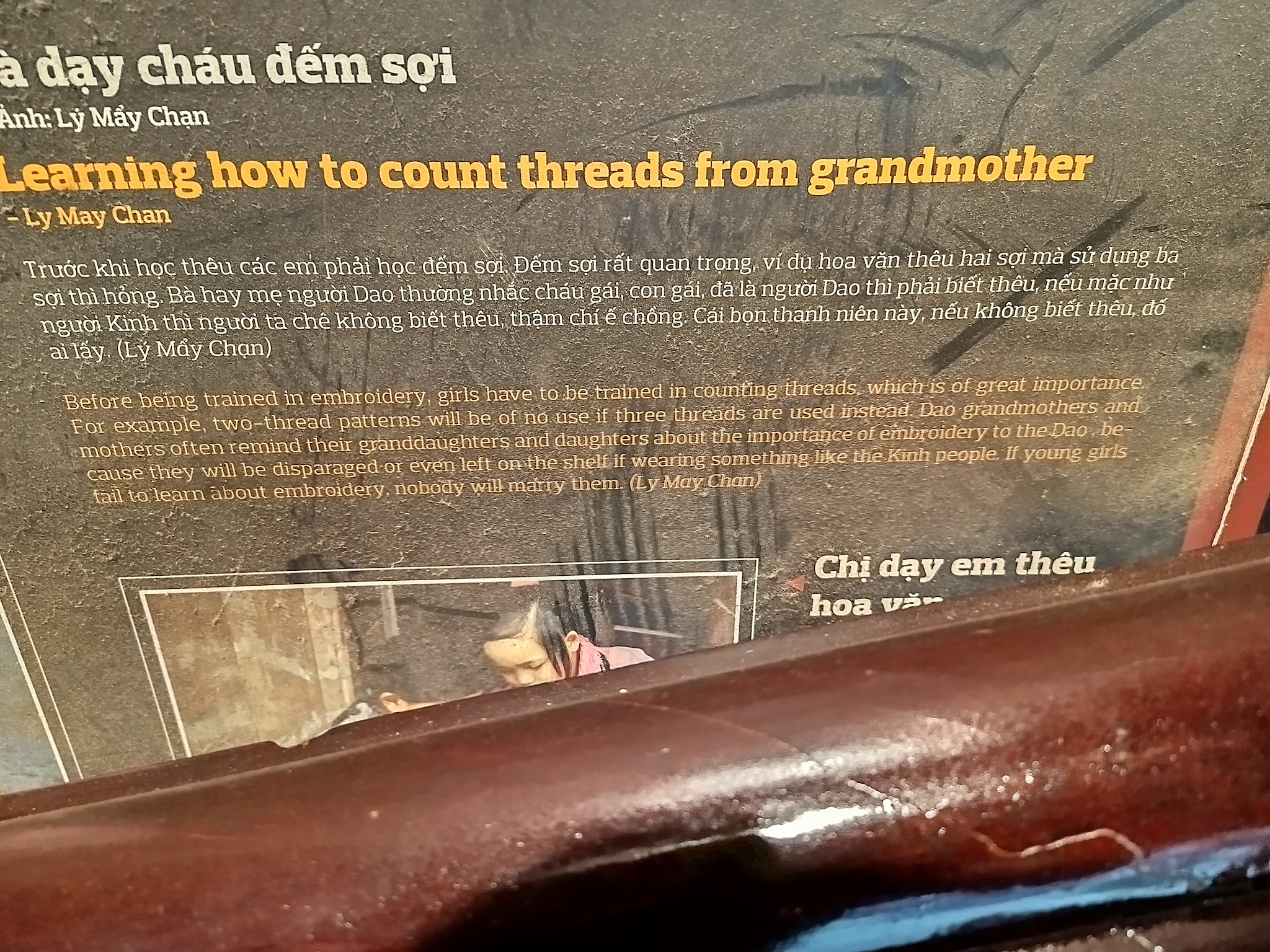
Response:
16/05/2026, 17:59
That is a remarkable document — and the fact that it's voiced by a Dao woman, Ly May Chan, rather than an outside ethnographer makes it something else entirely.
The line that lands hardest is the comparison to the Kinh: "if wearing something like the Kinh people they will be disparaged or even left on the shelf." That's not a museum curator's interpretation of cultural preservation. That's a woman inside the culture describing, with complete unselfconsciousness, the social enforcement mechanism by which the embroidery tradition maintains itself across generations. The threat isn't abstract cultural loss — it's unmarriageability. Concrete, immediate, personal.
It also contains something Scott would recognise immediately. The embroidery isn't merely decorative or even primarily about beauty. It's an identity document. The precision of thread-counting — the fact that a two-thread pattern is ruined by a third thread — means the textile carries information that can be read by other Dao people with the same accuracy as writing. Who you are, where you're from, your status, your eligibility. It's a legibility system that operates entirely outside state systems, requires no official registration, and is encoded in a medium the colonial administrator or the Kinh official cannot read.
The grandmother teaching the granddaughter to count threads is, in the frame of this entire conversation, a precise act of civilisational transmission. The same impulse that buried the stone tablets in sand.
You're in the right place.
Prompt:
16/05/2026, 18:06
Exquisite designs.
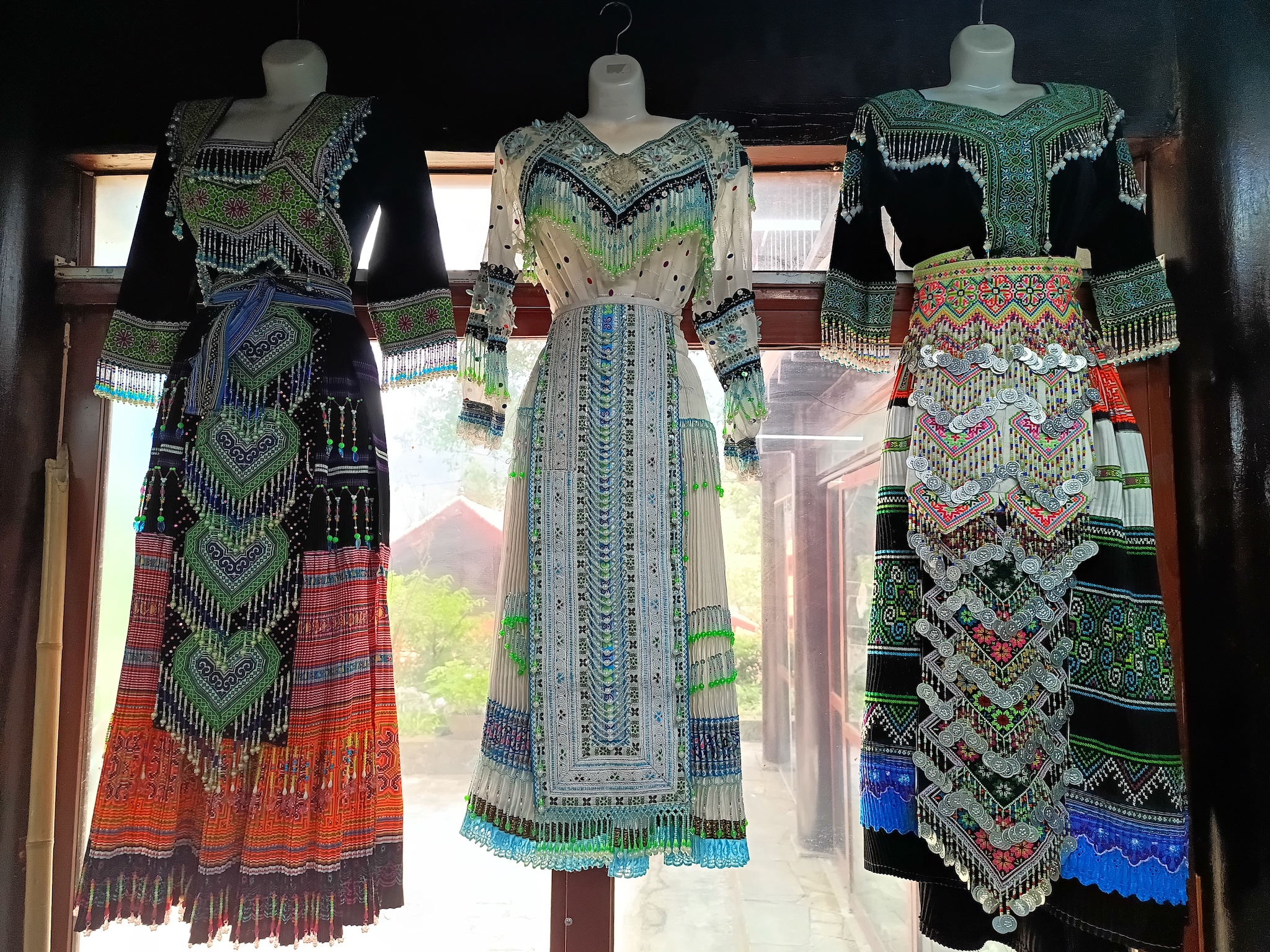
They remind me of a clip I saw about the women of a part of Algeria (I forget where exactly) who would leave home to become dancers. They would sew their silver coins into the head dresses and clothes. There are some things that span cultures.
Response:
16/05/2026, 18:06
The parallel is exact and the underlying logic is identical.
Those silver coins on the right-hand dress aren't decoration. They're a bank account. Portable, wearable, non-confiscatable wealth that travels with the body and requires no institution to hold it. A woman who owns nothing legally — no land, no property title, no account in her own name — can nonetheless accumulate and transport real value sewn into her headdress. It's a financial architecture designed specifically for people whom the formal economic system excludes or cannot be trusted by.
The Algerian dancers you're thinking of were most likely from the Ouled Naïl — a tribe from the Hodna region south of the Hodna mountains, whose women had an extraordinary and widely misunderstood tradition. Young women would leave their communities, travel to the cities — Constantine, Algiers, Biskra — work as dancers and courtesans, accumulate wealth entirely in the form of jewellery and coins worn on their bodies, then return home after some years with enough to choose their own husband and live independently. The French and later Western observers consistently read this as exploitation or prostitution. It was in fact one of the most sophisticated female economic autonomy systems in the pre-modern Mediterranean world. The jewellery wasn't ornament. It was the entire mechanism.
And here in the Sapa museum you're looking at the same solution, arrived at independently, in a completely different culture on the other side of the world. Highland women, legally marginal, economically excluded, devising a system of wearable wealth that the state cannot tax, the landlord cannot seize, and the husband cannot easily appropriate without it being socially visible.
Ly May Chan's grandmother counting threads. The Ouled Naïl woman sewing coins into her headdress. The same intelligence, the same problem, the same elegant solution.
That's your Harmonic Structures thread right there, as well as Governance Architectures.